
Monthly Archives: February 2026

A Focal Point on Radiology AI?

The FDA has selected Rick Abramson to lead the agency’s Digital Health Center of Excellence (DHCoE).

On paper, it’s a straightforward personnel move: a physician-executive with digital health experience steps into a role created to help the agency keep pace with software-driven medicine. In practice, this looks like a flare signal, because it lands right as FDA is reworking how it regulates AI and other digital health products, and just weeks after the agency publicly described a lighter-touch posture for parts of the market.

What’s (perhaps more) interesting is that Rick is a diagnostic radiologist. One with a heavy radiology AI résumé in the commercial space.

I have had the fortune of several conversations with Rick as I chaired the ACR Data Science Summit over the past few years, and then in a few personal conversations. Along with the combination of imaging AI, commissioner’s office policy exposure, DHCoE leadership, I’m interested in seeing what comes out of this CoE and will be following closely.
When AI Saves Time but Steals Your Evening

There is a lot of AI-generated, AI-related content out there lately. This HBR article seems to stand out with interesting findings. It’s behind a paywall, but here are the takeaways.

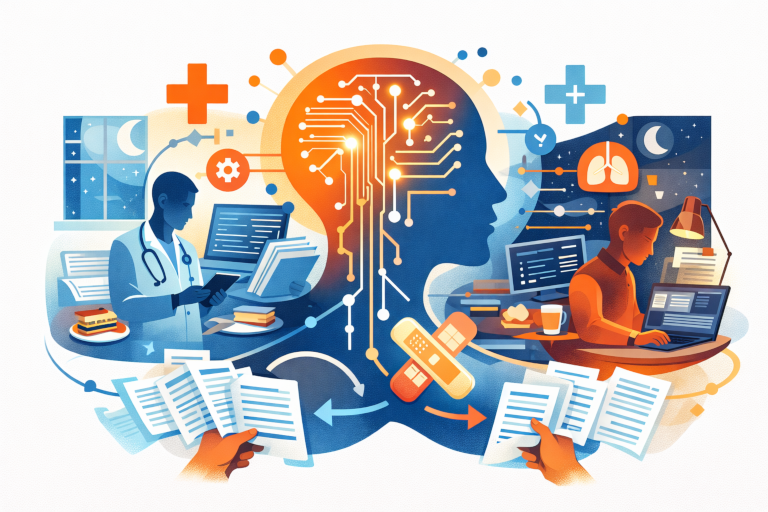
Generative AI was supposed to buy us time. An eight-month field study inside a ~200-person U.S. tech company suggests it can do the opposite: it intensifies work.

  • First, AI lowers skill barriers, so people take on tasks they previously wouldn’t. This means designers writing code, analysts drafting research, clinicians spinning up analyses. That feels empowering, but it also creates downstream “cleanup” work for others who must review, correct, and integrate AI-assisted output.
  • Second, AI makes work frictionless enough that it seeps into the in-between moments. Lunch breaks, late evenings, the quick “one more prompt.” The result is blurrier boundaries and less real recovery.
  • Third, AI encourages parallelism: multiple drafts, multiple threads, constant checking. That boosts throughput, but it also fragments attention.

The article goes on to describe a vicious cycle in which the more your colleagues do it, the more it becomes a culture, one in which you feel compelled to keep up. Using more AI.

I’ve felt a version of this personally. A few years ago, I stopped blogging regularly to make more time for kids and life outside work. With generative AI, getting a post out is genuinely easier. It’s a idea and some prompts, edits, and reviews away. But it still has to happen sometime… which, for me, often means well into the evening, in the dark, with the quiet (adorable) snoring noises of kids nearby.

Continue reading

What Radiology Teaches Us About AI and the Workforce

Health systems frequently ask whether artificial intelligence will ultimately reduce the need for clinicians. Radiology provides one of the clearest real-world answers to date. AI changes the mechanics of work far more than it changes the need for expertise.

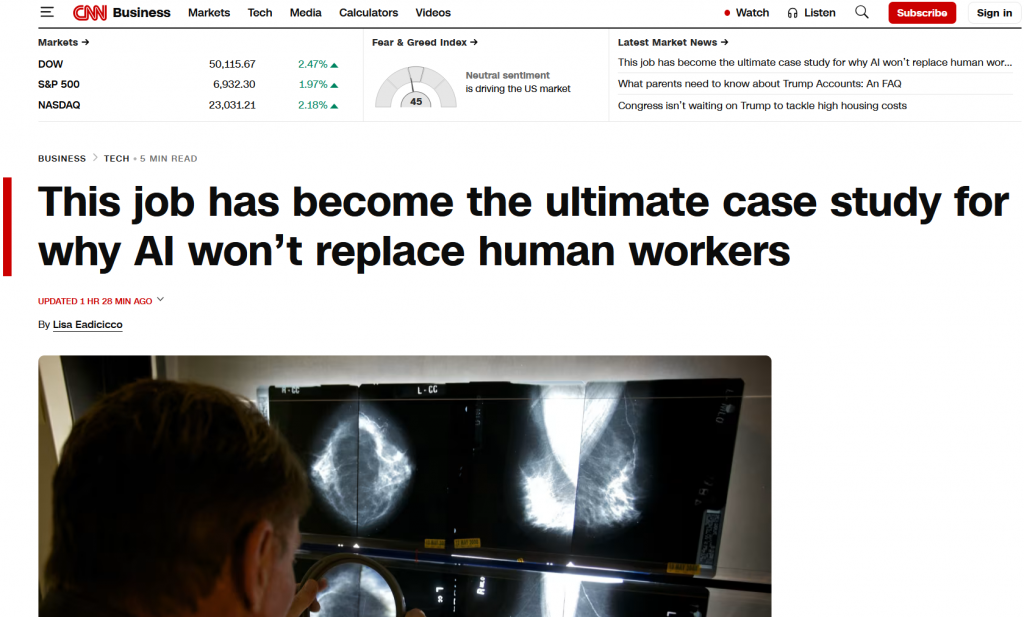
I had the privilege to speak with CNN on this topic recently. The story is out now.

In imaging operations, AI is already being used to support exam prioritization, improve image reconstruction, and reduce friction in routine workflows. These contributions are meaningful, particularly in high-volume environments. But they do not displace clinical judgment, professional accountability, or responsibility for patient outcomes. In practice, the performance gains attributed to AI are inseparable from expert oversight and careful integration into clinical teams.

We use AI as a capacity and quality multiplier, not as a substitute for our training. That line is difficult to walk and gets thinner as products improve, but the thought matters. Deploying it primarily as a justification for workforce reduction or skill substitution introduces avoidable risk to patient safety and physician trust.

Success ultimately go to those investing in workflow, governance structures, and building solution that define clear roles for both humans and machines. Radiology may be an early example, but the underlying lesson extends well beyond imaging.