Category Archives: Residency Productivity ‘Hacks’

Radiology residents have so much to learn in so little time. These blog posts document how I try to keep on top of it all.

AI Can Raise the floor, But People Determine The Ceiling.

AI readiness is often treated as a technical skill, as though one could study for it, take a test, and be done. It is a pitfall particularly in education – what does it even mean to teach residents to be ready for the AI age?

Researchers at UT Austin asked 523 early-career professionals to do client-like work with an AI agent, then compared their results with an AI-only baseline. About half were “AI Amplifiers”: they did better than AI alone. A quarter were “Delegators”: their work was about as good as the AI’s. The rest, “Apprentices,” did worse, even though they were not necessarily less capable.

Yes – about a quarter of the early-career professional appeared to produce worse outputs when using AI compared to than just having it done by AI alone. (The reality is probably that the researchers were better prompt engineers than the apprentices).

Strong users framed the problem, used real domain knowledge, checked the output, and refined it over several rounds. AI was used as a collaborator that needed direction and oversight.

This feels familiar in resident education. An algorithm can produce a useful first pass. Safe clinical value still depends on whether the clinician asks the right question, spots what does not fit, and knows what to do next.

The lesson is not to teach longer prompts. It is to teach judgment in the workflow: frame, check, refine, decide.

AI can raise the floor. People still determine the ceiling.

Source: McCombs School of Business, University of Texas at Austin.
5 Free Productivity Tools for the Radiology Resident

If you are a radiology resident, you probably spend more than eight hours a day in front of a computer.  Just as a cardiologist might spend hours looking for the best-in-class stethoscope and a neurologist a perfectly balanced reflex hammer, a radiologist might do well to spend some time thinking about spiffing up your workstation.

These are not radiology-specific tools.  They are also not mind-blowing innovations.  Instead, their existence often go unnoticed.  Like air, some tasks that these programs help you with are so ubiquitous you may not even even realize they could be improved.

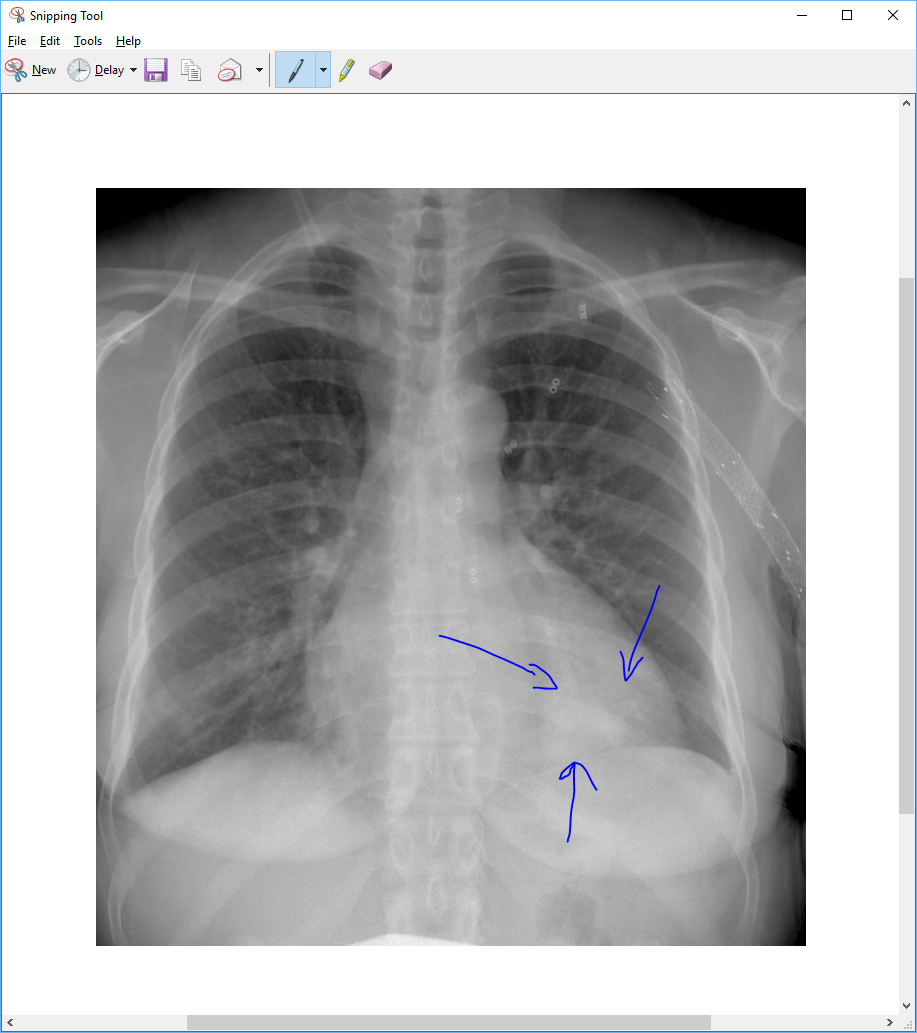
Snipping Tool

Screen capturing is easy as 1, 2, 3

There is always a role for downloading full resolution TIFF images for publication purposes.  However, sometimes you just want a simple screenshot for case conference or teaching file.

Fortunately, there’s a one that is on just about every modern Windows machine.

Continue reading

Don’t Go to The RSNA for The Great Research

The Radiology Society of North America (RSNA) annual conference is one of the most popular and most well-attended conferences in radiology.  The deal is the same – you submit some academic work you completed, and if it is deemed worthy, you are offered a not-quite-golden ticket to attend the not-quite-chocolate-making conference center.

You spend upwards to one week in a place with 20,000 strangers pushing around, 4,000 some CME-worthy offerings, and another 700 vendors trying to decide whether you have money to buy a CT table.  Sometimes people say that you go to the RSNA conference to learn about the newest research, to get ideas from being bathed in the sheer high density of smartness that we assumed would somehow disperse by diffusion.  The research is great, the vendors are great, the city is amazing, but these aren’t the reasons to go to the RSNA conference. If the research is important enough you will see it in a journal, if you need a product you will find that vendor on the internet, and Chicago… is indeed amazing, but it would be more so in September than December.

The reason that tens of thousands of people come together on this one week is not for the great research.  It’s for each other.  Go for the great people.  The world-class research is just a bonus.

Registration Now Open

Radiology’s largest annual conference is held in Chicago this year from Nov 29 – Dec 4

If You Must Multitask, Do It Well

busyphone

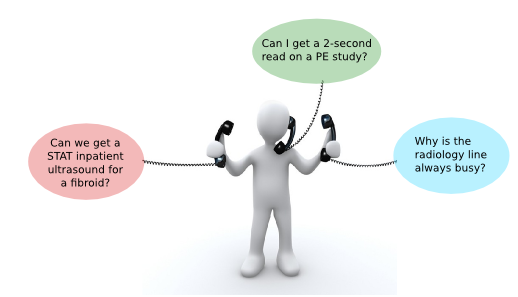
In the radiology reading room it is easy to get distracted.  Phone calls, clinician visits, and of course, the actual study that sits on the screen.

For a second year resident taking night call at Hospital of University of Pennsylvania, independent interpretation is just half of the challenge (and one I describe as The Gorilla Detection Exercise).  The other half comes from managing phone calls, protocols, and physician consultations.

Quote… humans do not have Intel Inside. We suffer dramatic performance cuts because of the task-switching overhead.

Continue reading

4 Ways Radiology Resident Experience Determines the Quality of a Residency

You are a fourth year medical student.  You’ve worked hard for three years, passed the USMLE with flying colors, conducted some spectacular extracurricular work.  And you’ve decided to pursue diagnostic radiology.  Continue reading

Can Gamification Improve Learning Effectiveness? (Spoilers: I Don’t Know)

This post is part of a series on preparing for the radiology core exam.

No, I don’t actually have the answer to the whether gamification can improve learning effectiveness.

But my radiology class might find out first hand through our QBank Challenge!

Continue reading

Preparing for The Radiology Core Exam

This is the first in a series of posts about preparing for the radiology core exam.

September is an interesting month for third year residents.  Your upper class residents finished the core exam 2-3 months ago and receive their scores in August.  The new editions of preparation books for the next year are often published around this time.

And, if you are like me, September is the month you might do some practice cases from a question bank and realize the  you have a lot of work to do.

This series of periodic short posts will documents the progress of my core exam preparation.  I am at best a mediocre test taker who happens to procrastinate a lot; this is a bad combination for standardized testing.  By keeping this series, hopefully I can keep up with what will be an overwhelming volume of information that I will have to know.

When to Get Involved in Extracurricular Scholarly Work?

Starting a new residency is tough. With new opportunities come new challenges: balancing between learning a new discipline and getting involved in scholarly endeavors can be stressful in its own right.

A sound advice I heard as a first year resident was to hold off unnecessary involvement early during the residency. A free license to procrastinate.

However, procrastination implies a postponing of something inevitable, not to mention that research and quality improvement projects are parts of the residency requirement.

So the question remains, when does it make sense to get involved? And how? Continue reading

The Bliss of Zero

The clock hit 7pm. My thumb off the deadman switch on the dictaphone. The glow of the reading room workstation monitors reflected off my glasses. I squinted. A click of the mouse. A curious pause.

And then there it was. I saw…

Nothing. A worklist with zero unread exam.

Inbox zero, Epic Radiant variant.

Continue reading

Organizing OneNote to Rock Your Radiology Training

Radiology residents have a massive volume of information to keep track of in the discipline, consisting of texts, images, and sometimes videos.

The variety of data type is made more complex by the data sources, from website clippings, PDF from PubMed, a slide from noon conference, or simply freehand typing.

To complicate matters, a resident also must keep abreast many sets of requirements, documentations, conferences, reimbursements, and academic projects.

How do you keep track of it all? Continue reading