Monthly Archives: August 2026

Learning AI From Radiology’s Messy Middle

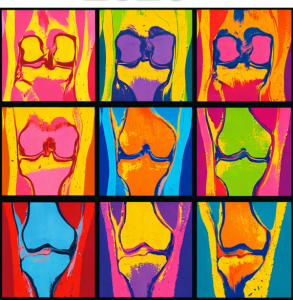
I am frequently asked by high school and college students what AI in radiology means, and by residents how to enter the technical side of imaging AI models. More importantly, how to build one from the real life of radiology?

This year’s RSNA Knee Abnormality Detection Challenge is one answer.

It is not a pristine tutorial dataset. Competitors will work from carefully pooled knee MRI images and their reports in 10 languages, sourced from 19 sites across 5 continents: the hedges, imperfect descriptions, and occasional errors that make clinical data both difficult and familiar.

The task is also not accuracy at all costs. Models must be efficient, and they must address a representative set of 12 knee abnormalities, not one model for one diagnosis.

That tension is the point. Building useful AI means confronting what radiology actually produces, then deciding what is worth measuring and improving.

As of August 17, there have been 12,853 joined users, 1,890 competitors across 1,761 active teams, and 11,456 submissions; the public leaderboard’s top, median, and last-listed scores are 0.951, 0.8745, and 0.468, respectively.

I am grateful to the RSNA staff, the Challenge Task Force, and especially Dr. Errol Colak for their leadership. I am equally thankful to my co-lead, Dr. Naveen Subhas. This Challenge could not have been pulled together by just one team: we owe this work to over 100 radiologists, biostatisticians, and data scientists across the world who volunteered their time reviewing reports, annotating images, offering advice, and contributing data.

We hope this challenge gives learners a practical place to begin and a clearer sense of the questions that remain.

AI Can Raise the floor, But People Determine The Ceiling.

AI readiness is often treated as a technical skill, as though one could study for it, take a test, and be done. It is a pitfall particularly in education – what does it even mean to teach residents to be ready for the AI age?

Researchers at UT Austin asked 523 early-career professionals to do client-like work with an AI agent, then compared their results with an AI-only baseline. About half were “AI Amplifiers”: they did better than AI alone. A quarter were “Delegators”: their work was about as good as the AI’s. The rest, “Apprentices,” did worse, even though they were not necessarily less capable.

Yes – about a quarter of the early-career professional appeared to produce worse outputs when using AI compared to than just having it done by AI alone. (The reality is probably that the researchers were better prompt engineers than the apprentices).

Strong users framed the problem, used real domain knowledge, checked the output, and refined it over several rounds. AI was used as a collaborator that needed direction and oversight.

This feels familiar in resident education. An algorithm can produce a useful first pass. Safe clinical value still depends on whether the clinician asks the right question, spots what does not fit, and knows what to do next.

The lesson is not to teach longer prompts. It is to teach judgment in the workflow: frame, check, refine, decide.

AI can raise the floor. People still determine the ceiling.

Source: McCombs School of Business, University of Texas at Austin.

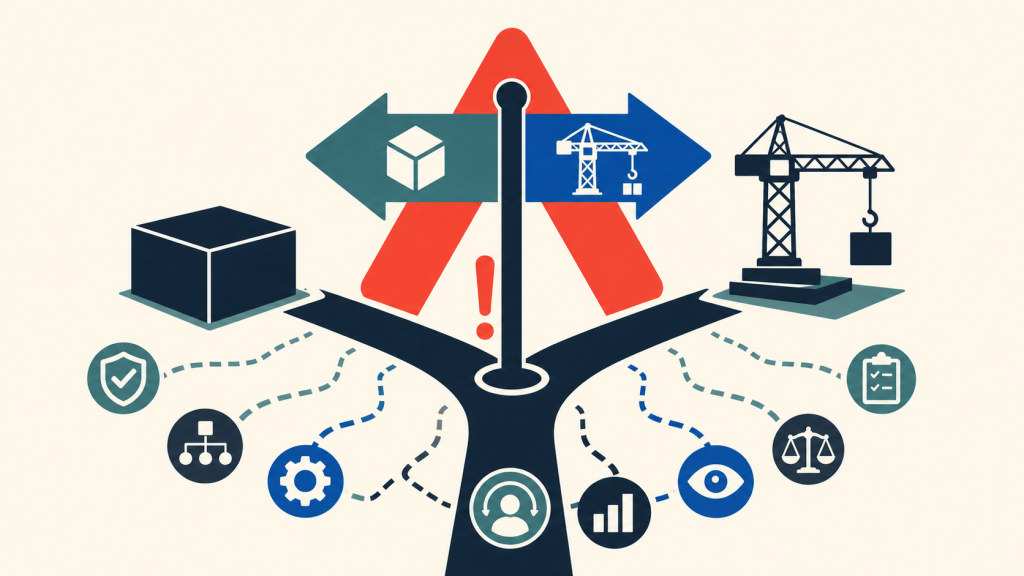
Navigating AI Decisions: Going Beyond “Buy vs Build”

Conceptual illustration of an AI buy-versus-build crossroads with governance and monitoring decisions

“Should we buy or build?” is usually the first question organizations ask about radiology AI. It is useful, but it is no longer the whole question.

Today, you can choose from cleared clinical algorithms, enterprise AI platforms, generative-AI tools, and internally developed workflows. The real challenge begins after a contract is signed or a prototype works. AI becomes another clinical system: one that can help, distract, confuse, or quietly change behavior.

Anyone who has lived through an enterprise IT rollout, PACS replacement, or hospital merger (let alone lead an aspect of it) knows the pattern. Installation is only one part of deployment. The hard work is making a tool fit the people, data, incentives, exceptions, and failure modes of the place where it will be used.

Continue reading