
Tag Archives: AI education

RSNA 2026 Knee MRI Challenge: Early Momentum

The RSNA 2026 Knee MRI Challenge is gaining remarkable momentum, and I am deeply grateful to everyone contributing. It’s been both a fulfilling and a humbling experience. As of August 29, more than 16,700 people have joined, with nearly 2,900 competitors forming over 2,600 teams and submitting more than 24,700 models.

Almost 500 public notebooks and 85 forum topics reflect a community that is not just competing, but actively teaching and learning. Participation and iterative activity continue to rise, while both leading and median public leaderboard performance have strengthened impressively.

What excites me most is the conversation. Data scientists, trainees, and licensed radiologists from around the world have posted on the discussion boards about the challenge design, the dataset, and the realities of clinical data. Discussions about why there is no beautifully crafted “ground truth,” and what to do with nuanced, free-text radiology reports, go directly to the educational mission of this challenge. These are not side questions; they are central to building useful, clinically meaningful AI.

I am extremely impressed by the competitors’ performance so far, and thankful for the rigor, curiosity, and generosity participants are bringing to the challenge.
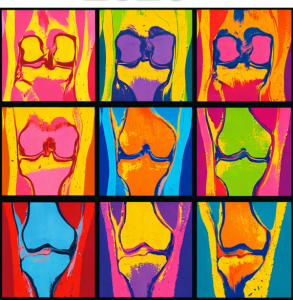

Learning AI From Radiology’s Messy Middle

I am frequently asked by high school and college students what AI in radiology means, and by residents how to enter the technical side of imaging AI models. More importantly, how to build one from the real life of radiology?

This year’s RSNA Knee Abnormality Detection Challenge is one answer.

It is not a pristine tutorial dataset. Competitors will work from carefully pooled knee MRI images and their reports in 10 languages, sourced from 19 sites across 5 continents: the hedges, imperfect descriptions, and occasional errors that make clinical data both difficult and familiar.

The task is also not accuracy at all costs. Models must be efficient, and they must address a representative set of 12 knee abnormalities, not one model for one diagnosis.

That tension is the point. Building useful AI means confronting what radiology actually produces, then deciding what is worth measuring and improving.

As of August 17, there have been 12,853 joined users, 1,890 competitors across 1,761 active teams, and 11,456 submissions; the public leaderboard’s top, median, and last-listed scores are 0.951, 0.8745, and 0.468, respectively.

I am grateful to the RSNA staff, the Challenge Task Force, and especially Dr. Errol Colak for their leadership. I am equally thankful to my co-lead, Dr. Naveen Subhas. This Challenge could not have been pulled together by just one team: we owe this work to over 100 radiologists, biostatisticians, and data scientists across the world who volunteered their time reviewing reports, annotating images, offering advice, and contributing data.

We hope this challenge gives learners a practical place to begin and a clearer sense of the questions that remain.

AI Readiness as an Educational Obligation

I wrote a guest editorial in Academic Radiology about AI readiness as a practical educational obligation, rather than an optional informatics side quest.

The piece responds to a study of medical undergraduates and radiology trainees in China, but the issue is broader: enthusiasm and exposure do not equal competence. Radiologists need enough AI literacy to recognize workflow fit, automation bias, governance gaps, and the limits of machine suggestions. Most trainees will not become model developers.

They still need to become safe, skeptical operators who can use AI with confidence and accountability in real clinical environments, worldwide, across diverse resource settings today.