Sway – The Way to Share Radiology Content in Web 3.0?

I stumbled upon Sway today.  Microsoft Sway promises to make creating web presentations easy, which is a fairly big claim.

I also happened to be studying MSK for the Core Exam, so I made a Sway approaches to mass lesions in bone. There will also be some comments on Sway.

Here’s the disclaimer: I am not an MSK expert, just some guy studying for the Core Exam!  Also, all images here belong to their original owners, not me.

Also, Sway’s navigation is a hybrid between ​PPT slide show and web-based scrolling. It takes a little getting-used-to.  Definitely try it in full screen, but it can also be embedded in a web page like this.

All in all, I was impressed with Sway, and I hope it continues to mature.

It did crash twice on me, but no content was lost as the app continuously saves your edits to the cloud the same way we have come to expect web apps.  Sway is the easiest way to create engaging content by removing the guesswork in design layout.  Whereas PowerPoint seems to encourage you to create bulleted lists after bulleted lists,  Sway encourages you to get your point across through pictures and videos.

I really like the direction the software is taking because this is how radiology content should be shared.

For someone who always needs to be doing something to keep focusing on the topic at hand, Sway kept me on task by providing an immersive environment for creating content. That’s always a plus.

5 Free Productivity Tools for the Radiology Resident

If you are a radiology resident, you probably spend more than eight hours a day in front of a computer.  Just as a cardiologist might spend hours looking for the best-in-class stethoscope and a neurologist a perfectly balanced reflex hammer, a radiologist might do well to spend some time thinking about spiffing up your workstation.

These are not radiology-specific tools.  They are also not mind-blowing innovations.  Instead, their existence often go unnoticed.  Like air, some tasks that these programs help you with are so ubiquitous you may not even even realize they could be improved.

Snipping Tool

Screen capturing is easy as 1, 2, 3

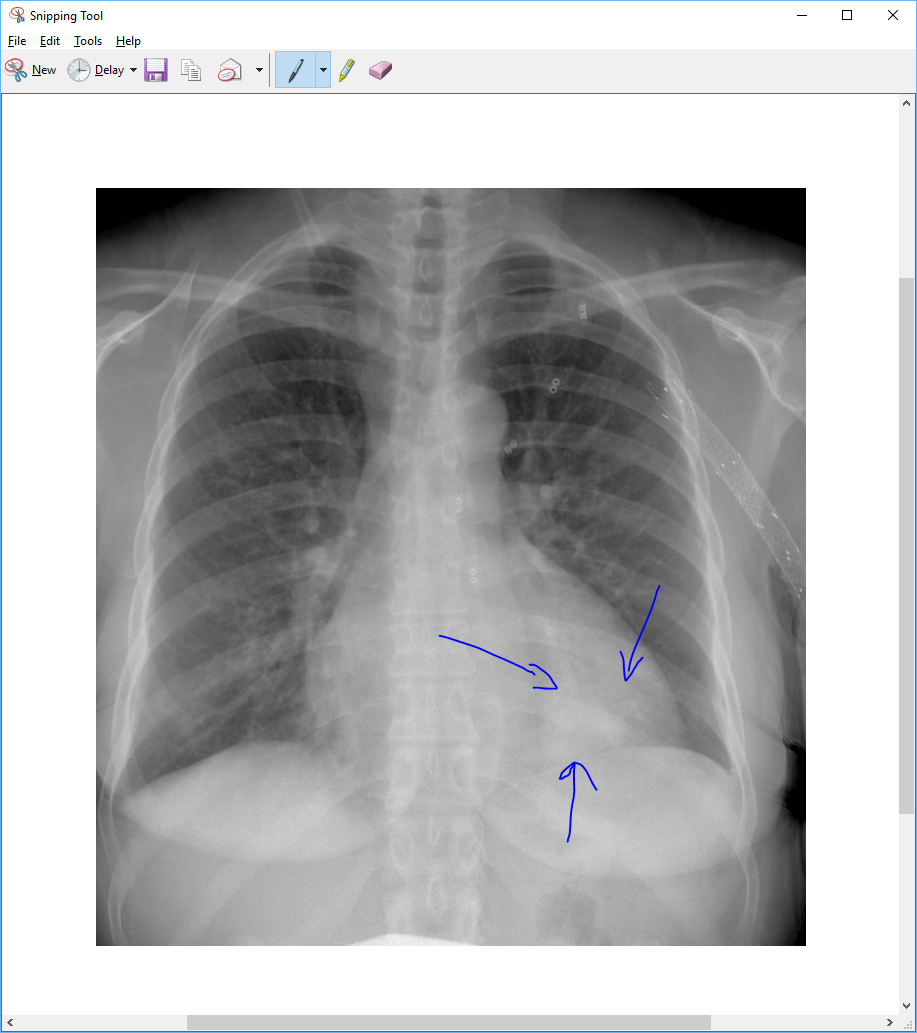
There is always a role for downloading full resolution TIFF images for publication purposes.  However, sometimes you just want a simple screenshot for case conference or teaching file.

Fortunately, there’s a one that is on just about every modern Windows machine.

Continue reading

Thinking of Snow

A friend did me a favor yesterday without being asked.  I asked him why.

He said earlier this week his neighbor decided to shovel snow for the entire block. The neighbor dug out everyone’s cars from several feet of deep snow.

The cynical might endorse The Chain of Screaming, but the opposite is equally true.  In the aftermath of the most severe blizzard the northeast has seen in recent years comes a warm act of kindness.

Cynicism and kindness are both contagious.  Which one will you spread?

Know Your Informatics Architect

One of the biggest mistakes you can make in an informatics project is to assume that your Architect is “just a programmer.”

It is easy to fall into a search for “hard” technical skills when looking for technical talent: Do you know SQL?  Are you Microsoft certified?  Can you code a machine learning algorithm in Python?

These are important skills, to be sure.  However, just like radiologists are all different and that clinical knowledge is only one of many facets,  potential gaps in technological capabilities is also important.

The Architect also needs to know the data infrastructure of the organization.  In a large healthcare organization, she also needs a good rapport with the other experts in the organization.

The Architect often knows solutions without knowing that there exists a problem.  More than just the programming and technical hard skills, the Architect can be counted on to mobilize the necessary resources.

Knowing your informatics Architect’s specialization and corresponding limitations can save you months of work.

The Best Time to Be A Radiologist   

Radiology is probably the most exciting field of medicine to be in right now.

Yes – reimbursements are less generous.
Yes – volume is paradoxically increasing, and we are busier than ever.
Yes – you spend most of your time away from patients.

Physicians are inherent scientists. We observe a pattern and draw a line of extrapolation. We do this subconsciously and assign value to these insights. If reimbursement decreased by 10% from last year, in 12 years we will be left with 35% what we started with!  However, we now know drawing lines using historical data requires a nuanced approach.

The best time to get involved in a profession as a young professional is at a time of rapid change. History records only times of conflict, of artistic or cultural debate, of Renaissance, the industrial revolution, and the digital age. Change is the enemy of stability and favors the adaptable. Change gives rise to new ideas and new efforts. Change is why Silicon Valley start-ups rise and fall with the ticking clock but yet remain some of the most exciting careers in today’s America.

It is in the midst of fluctuation, not stability, that we find the most fulfilling career opportunities. Radiology doesn’t guarantee success – your medical training did that for you. Radiology offers an environment to be creative precisely because so much of its future is in the air rather than in stone carvings.

So will you seize the unique opportunity and guide the flow of an entire medical discipline at a time of your life when you are best suited for it? If you have always been fascinated by medical imaging, now is the time to jump in.

You Don’t Have to Outrun The Bear

I had a wonderful discussion with an old friend from college who was trying to learn more about radiology. A computer scientist classically trained in a top US university for software engineering, she has years of experience in data science. She is now trying to apply her extensive expertise in analytics to healthcare. In our discussion, she began to express her concerns – having taken only 1 introductory biology course in college, she was worried that her limited knowledge in healthcare and medicine will prove to be the lynchpin of this transition.

Continue reading

Complexity of Communication in Diagnostic Radiology

In diagnostic radiology, information is the currency. Although the clinical knowledge in diagnostic radiology is the most salient component, information in radiology comes in many forms. What is the most appropriate next step in diagnosis? What is the most appropriate way to explain the clinical impact of this incidentally noted, indeterminate adrenal nodule? How to describe this finding in the most understandable way now that our patients are reading our reports?

Image Credit: Larson et al, AJR, Figure 2

Continue reading

Don’t Go to The RSNA for The Great Research

The Radiology Society of North America (RSNA) annual conference is one of the most popular and most well-attended conferences in radiology.  The deal is the same – you submit some academic work you completed, and if it is deemed worthy, you are offered a not-quite-golden ticket to attend the not-quite-chocolate-making conference center.

You spend upwards to one week in a place with 20,000 strangers pushing around, 4,000 some CME-worthy offerings, and another 700 vendors trying to decide whether you have money to buy a CT table.  Sometimes people say that you go to the RSNA conference to learn about the newest research, to get ideas from being bathed in the sheer high density of smartness that we assumed would somehow disperse by diffusion.  The research is great, the vendors are great, the city is amazing, but these aren’t the reasons to go to the RSNA conference. If the research is important enough you will see it in a journal, if you need a product you will find that vendor on the internet, and Chicago… is indeed amazing, but it would be more so in September than December.

The reason that tens of thousands of people come together on this one week is not for the great research.  It’s for each other.  Go for the great people.  The world-class research is just a bonus.

Registration Now Open

Radiology’s largest annual conference is held in Chicago this year from Nov 29 – Dec 4

Towards Healthcare Interoperability: What Must Be Done?

Interoperability is becoming the most sought-after in healthcare, but needs further standardization.  Image Credit: http://cloudpro.co.uk

A few days ago, Walgreens announced a new deal with Epic Systems, joining numerous health systems (and one of its major competitors, CVS) by implementing Epic’s famous electronic health records (EHRs). In its press release, Walgreens cited interoperability as one of the primary reason for this transition:

QuoteThis state-of-the-industry EHR will enable more seamless communication with health systems and local providers, and gives us enhanced capabilities to deliver better health outcomes through greater care coordination and interoperability.”

Interoperability has become the holy grail of technology adaptation in many industries.  Continue reading

If You Must Multitask, Do It Well

busyphone

In the radiology reading room it is easy to get distracted.  Phone calls, clinician visits, and of course, the actual study that sits on the screen.

For a second year resident taking night call at Hospital of University of Pennsylvania, independent interpretation is just half of the challenge (and one I describe as The Gorilla Detection Exercise).  The other half comes from managing phone calls, protocols, and physician consultations.

Quote… humans do not have Intel Inside. We suffer dramatic performance cuts because of the task-switching overhead.

Continue reading