Don’t Go to The RSNA for The Great Research

The Radiology Society of North America (RSNA) annual conference is one of the most popular and most well-attended conferences in radiology.  The deal is the same – you submit some academic work you completed, and if it is deemed worthy, you are offered a not-quite-golden ticket to attend the not-quite-chocolate-making conference center.

You spend upwards to one week in a place with 20,000 strangers pushing around, 4,000 some CME-worthy offerings, and another 700 vendors trying to decide whether you have money to buy a CT table.  Sometimes people say that you go to the RSNA conference to learn about the newest research, to get ideas from being bathed in the sheer high density of smartness that we assumed would somehow disperse by diffusion.  The research is great, the vendors are great, the city is amazing, but these aren’t the reasons to go to the RSNA conference. If the research is important enough you will see it in a journal, if you need a product you will find that vendor on the internet, and Chicago… is indeed amazing, but it would be more so in September than December.

The reason that tens of thousands of people come together on this one week is not for the great research.  It’s for each other.  Go for the great people.  The world-class research is just a bonus.

Registration Now Open

Radiology’s largest annual conference is held in Chicago this year from Nov 29 – Dec 4

Towards Healthcare Interoperability: What Must Be Done?

Interoperability is becoming the most sought-after in healthcare, but needs further standardization.  Image Credit: http://cloudpro.co.uk

A few days ago, Walgreens announced a new deal with Epic Systems, joining numerous health systems (and one of its major competitors, CVS) by implementing Epic’s famous electronic health records (EHRs). In its press release, Walgreens cited interoperability as one of the primary reason for this transition:

QuoteThis state-of-the-industry EHR will enable more seamless communication with health systems and local providers, and gives us enhanced capabilities to deliver better health outcomes through greater care coordination and interoperability.”
Interoperability has become the holy grail of technology adaptation in many industries.  Continue reading

If You Must Multitask, Do It Well

busyphone

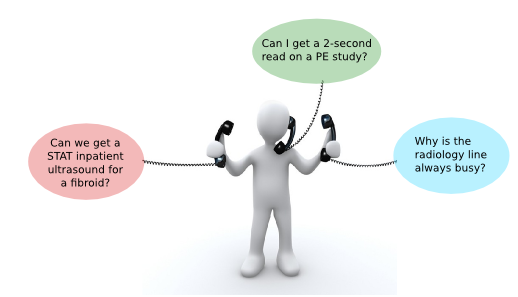
In the radiology reading room it is easy to get distracted.  Phone calls, clinician visits, and of course, the actual study that sits on the screen.

For a second year resident taking night call at Hospital of University of Pennsylvania, independent interpretation is just half of the challenge (and one I describe as The Gorilla Detection Exercise).  The other half comes from managing phone calls, protocols, and physician consultations.

Quote… humans do not have Intel Inside. We suffer dramatic performance cuts because of the task-switching overhead.

Continue reading

Be a Radiology Informatics Visionary

In The Four Steps to the Epiphany, Stephen Clark describes an “Earlyvangelist,” with the prefix “early” referring to a champion a the very early stage of a product adaptation cycle.

Since our emphasis is on problem and not the product, a different term might be more appropriate.  I will refer to this person as The Visionary.

The Visionary comes from the “problem end” of informatics. The Visionary is observant and asks good questions. She has a pain point. She knows when things just don’t look quite right. She may not know what the solution looks like. She may not even know that a solution exists. Marketers like Visionaries because these people see problem and can see the potential of the new purchase.

The Visionary is what all radiologists interested in informatics should be.  We see the clinical problem in a way that no software developer and no administrator can see.  Sitting down and accepting the status quo runs the risk of burying the problem forever.

Relaxing the Quality MOC Requirements – Good News or Bad Omen?

In September, the American Board of Radiology (ABR) released a set of expanded options for satisfying Part 4 Requirements for its maintenance of certification (MOC).

The biggest change includes the ABR’s willingness to include additional areas (16 of them) of involvement in departmental quality and safety other than Practice Quality Improvement (PQI) as qualifying requirement. Continue reading

4 Ways Radiology Resident Experience Determines the Quality of a Residency

You are a fourth year medical student.  You’ve worked hard for three years, passed the USMLE with flying colors, conducted some spectacular extracurricular work.  And you’ve decided to pursue diagnostic radiology.  Continue reading

Healthcare Data Analytics – The Time to Act Is Now

This recent Deloitte healthcare analytic report came out with focus on big data.  The report aims to identify current state of data analytics as well as emerging trends in healthcare.

The 30-Second Recap?

Most organizations believe data analytics is important, but less than half have a clear strategy to approach it.  Few (5 of 50 surveyed organizations) anticipate an increase in budget.  Those who did invest describe the most important drivers as improve clinical outcomes, deliver value-based care, and reduce operating costs.

And then there’s my favorite figure, reproduced from the Deloitte report:  Continue reading

Can Gamification Improve Learning Effectiveness? (Spoilers: I Don’t Know)

This post is part of a series on preparing for the radiology core exam.

No, I don’t actually have the answer to the whether gamification can improve learning effectiveness.

But my radiology class might find out first hand through our QBank Challenge!

Continue reading

After Big Data—Keep Healthcare Ahead with Internet of Things

In a way, healthcare has spearheaded the forefront of universal connectivity with common objects. In the world of Big Data, healthcare is now uniquely positioned to take the next step.

A few years ago, I needed hand surgery. Shortly after checking in to the outpatient surgery department, the helpful nurse attached EKG leads onto my arms and chest, and a pulse oximeter to my finger. The monitor next to my bed flickered and came to life. Then, colorful telemetric and oximetric tracings in a nursing station computer reflected an exact copy. A record in the hospital intranet traced my wellbeing overtime. Wireless connectivity allowed an extra pair of eyes to watched me and to ensure aberrant flickers do not go unnoticed… Continue reading

This article originally appeared in American Journal of Managed Care.

Preparing for The Radiology Core Exam

This is the first in a series of posts about preparing for the radiology core exam.

September is an interesting month for third year residents.  Your upper class residents finished the core exam 2-3 months ago and receive their scores in August.  The new editions of preparation books for the next year are often published around this time.

And, if you are like me, September is the month you might do some practice cases from a question bank and realize the  you have a lot of work to do.

This series of periodic short posts will documents the progress of my core exam preparation.  I am at best a mediocre test taker who happens to procrastinate a lot; this is a bad combination for standardized testing.  By keeping this series, hopefully I can keep up with what will be an overwhelming volume of information that I will have to know.